
Let's talk recapping
- izzygrin1
- Mar 17, 2021
- 3 min read
Updated: Mar 19, 2021
If you are a beekeeper, you have probably seen something like this in your hives:

Worker bees create small holes in caps of worker cells, usually it is seen in response to Varroa infestation however bees do also recap cells affected by wax moth. In Varroa infestation it is thought that the worker bees create holes after detecting a smell coming from within the cell. Currently the source of the smell is not 100% clear but it does appear to result from the interaction between the mite and the pupae as a recent study isolated a smell that was present on both the infested pupae and the mites offspring.
The smell triggers a sensitive hygienic bee that I will refer to as an “uncapper” to create a hole in the cap. It is then the job of a different bee to decide whether to remove the pupae. This decision is thought to be stimulated by a different smell than the hole creation. If the pupa is not removed a third bee will then recap the cell. This third bee or “recapper” bee has a much lower sensitivity than the uncapper bees and so will sometimes reseal infested pupae. Therefore, a balance of the types of hygienic workers is important.

Having too many sensitive “uncappers” can lead to bald brood, although despite the appearance this isn’t a problem for the colony as they will be recapped later.

The high sensitivity of the uncappers is also why so many healthy cells are recapped. Indeed, I discovered that these recapping events appear to occur in clusters around infested cells. It is thus believed that either the smell from infested cells may drift over healthy cells making them appear suspicious or that bees instinctively check the cells around infested cells. Either way many healthy cells are erroneously uncapped and thus recapping is important to prevent bees from removing healthy brood.
The image below is from my article “Spatial distribution of recapping behaviour indicates clustering around Varroa infested cells” it shows a brood frame with circles indicating the clusters of recapped cells and infested recapped cells.

Recapping is an important sign that your colony can detect Varroa. It is also much easier to measure than brood removal. In the lab I measure recapping of colonies for my work, but it is something anyone with bees can do. You simply need a scalpel, fine set of tweezers, a glass dish, a paint brush and a magnifier or microscope. Using the tweezers or scalpel you need to carefully cut around the edges of the cell cap and then peel it back. Like in the image below:

This is a photo I took of a recapped cell, you can tell it has been recapped because the shiny surface has been replaced by an area of matte wax particles. The underside of a cell is normally all shiny because of the cocoon shed by the pupa. If that is disrupted and replaced, you are left with a matte disc shape.
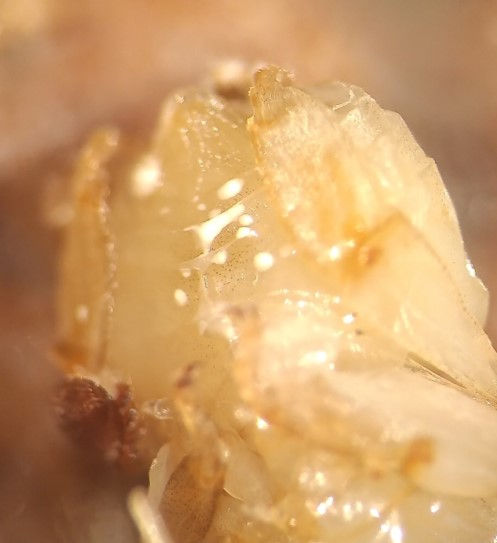
After peeling back, the cap of the cell, you need to remove the pupa to see if the cell is infested or not. When I removed the pupa from the cell, I discovered mites stuck to the pupa’s body and also within the cell.

You may also see the white mite poo, called frass, within the cell or on the pupa.

For my work I am interested in mite reproduction and so I carefully removed all the mites with a paint brush to show the complete mite family.

In the photo you can see the adult female which is the dark brown mite in the centre. The rest are her offspring, in the purple rectangle is a young adult female, which has undergone its final moult and shed the skin seen in the green triangle. In the red circle is an adult male who has also undergone its final moult, unfortunately I broke the skin he had shed and so it is not in the photo. The final three mites are female deutonymphs, the smallest is the youngest and has just gone from protonymph to deutonymph.


Comments