
Childless Mites
- izzygrin1
- Mar 31, 2021
- 2 min read
Updated: Apr 6, 2021
In every population of mites there is a small percentage (around 5% to 20%) that are infertile and an even more that do reproduce, but unsuccessfully. True infertility is when for some biological reason the foundress mite is unable to lay eggs. In contrast those that don’t reproduce successfully may actually lay eggs, but their reproductive cycle doesn’t result in at least one mature, mated female offspring. Mites of the latter definition are what appear to be increasing within colonies that are resistant.
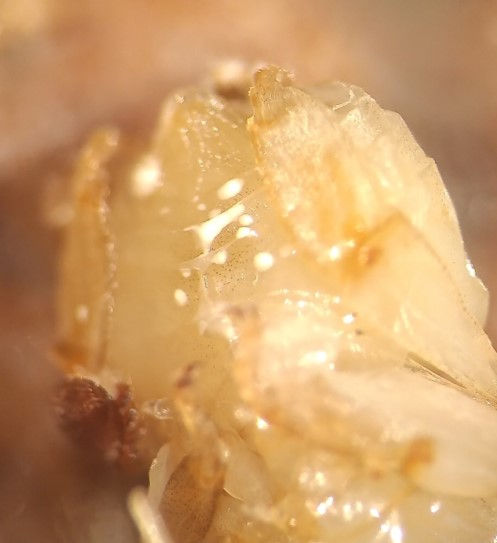
Image: Mites that don't reproduce often defecate on the pupa's body
Unsuccessful reproduction is thought to be the product of brood removal behaviour. This is because when an infested pupa is removed the foundress mites’ reproductive cycle is blocked and any offspring she has laid will die. The foundress herself can go on to infest another cell but is likely to be unsuccessful reproductively because her reproductive cycle has already begun. Indeed, the reproductive cycle of Varroa is normally very tightly synchronised with the development of the pupa. This is for two reasons, one because the mites have a limited time frame in which to lay the male and successive female eggs and for the offspring to mature and mate. And two because the mites use developmental factors that they get from feeding on the pupae to initiate different stages of their reproduction. A study found that mutations in the ecdysone pathway of pupae could prevent the initiation of vitellogenesis and reproduction in the mite (1).
In terms of brood removal, the asynchrony is likely because she has laid eggs in the original cell and so in the new cell may only lay female eggs. A missing male is a key cause of unsuccessful reproduction as any females produced cannot mate and so won't be able to lay their own fertilised eggs.

It is thought that they may be able to mate later if they enter a cell with another adult female, however whether this occurs often is unclear. Disruption of the synchrony is also thought to be caused by recapping behaviour. As it has been observed that in recapped cells mites have reduced reproductive success. This could be because the disruptions halt the reproductive cycle for a period of time thus meaning the mites have less time to mature and mate.

Image: close up of a mature male mite, notice the slightly brown legs
Ultimately, frequent interruption by brood removal and potentially recapping makes it more likely that a foundress will produce immature or unmated female offspring. In turn this will reduce the population growth of the mites and thus the number of mites within the colony. In resistant colonies the percentage of non-reproducing mites is approximately 46% which predicts that around 0.76 mature fertilised females are produced each reproductive cycle. This means that the mite population will not grow exponentially but will remain at a manageable size which will also mean that the colonies level of deformed wing virus will remain manageable enhancing the colonies survival.

(1) Conlon BH, Aurori A, Giurgiu AI, Kefuss J, Dezmirean DS, Moritz RFA, Routtu J. A gene for resistance to the Varroa mite (Acari) in honey bee (Apis mellifera) pupae. Mol Ecol. 2019 Jun;28(12):2958-2966. doi: 10.1111/mec.15080. Epub 2019 May 5. PMID: 30916410.


Comments