
Colony Hygiene
- izzygrin1
- Mar 24, 2021
- 4 min read
Considering the current pandemic, I thought it would be interesting to look at how honey bees prevent diseases spreading in their own colonies. As you probably know, honey bees like other social insects live in large groups called colonies. All the colony members live and work together in a dense aggregation, this kind of situation is prefect for diseases to spread. As a result, social insects have developed behaviours to help prevent this. One behaviour that appears in many social insect species is necrophoric behaviour (also known as undertaking behaviour) in which members of the colony remove the corpses of other members that have died. The benefit of this is it removes from the colony any infective elements (bacteria, fungus etc) that may be within the corpse and thus reduces the contact of other colony members with the infection.

A worker taking away a dead colony member. Taken from: sciencemag.org
Honey bees are no exception as they too perform necrophoric behaviour. There even some recorded cases that dying individuals will leave the hive to die elsewhere. However, it’s not just dead adult bees that are removed but also dead pupae. In fact, there are many brood diseases that could be devastating to a honey bee colony and so hygienic behaviour toward pupae is very important for a colonies survival. An important aspect of brood removal is being able to remove dead or dying individuals quickly. Removing them quickly helps to prevent the build up of infective elements such as bacterial or fungal spores.
An example is American foulbrood (AFB), this awful disease is caused by a bacterium known as Paenibacillus larvae. This bacterium produces spores that are highly resilient and can persist within a colony for decades. The spores only infect larvae that are less than 3 days old, when a larva is infected with AFB it will die, the bacteria will then break down the body to form a characteristic ropy mass. Finally, the bacteria will form spores and the larva’s body will dry to a hard scale. This hard scale is incredibly difficult for the hygienic bees to remove and will continue to infect other larvae. Thus, it is beneficial for bees to be able to detect the dead larva and remove it early.

The characteristic ropy mass can be stretched out with a matchstick forming a rope. Image taken from: beeaware.org

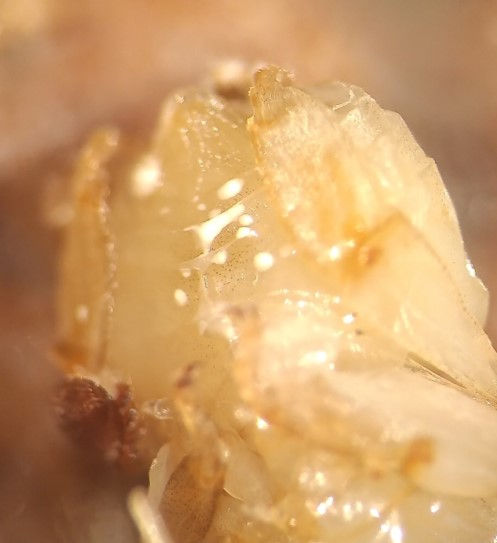
This photo shows the hard scale which contains millions of afb spores. I took this from an awesome and in depth article on AFB here's the link: https://pollinators.msu.edu/resources/beekeepers/diagnosing-and-treating-american-foulbrood-in-honey-bee-colonies/
Indeed, bees can remove pupae or larvae that are infected with a disease but have not yet succumb. It highly depends on the ability of the hygienic workers to “sniff out” any signs of disease. For instance, hygienic behaviour is also targeted towards Varroa infested cells. Varroa mites are unlikely to cause a pupa to die outright but infested pupae are still sacrificed either by being removed or cannibalised. In this case the cost of a pupa is worth it because emptying the cell means that any mite offspring produced would die, effectively blocking the foundress mite’s reproduction. The foundress mite that originally entered the cell will survive but she will have wasted some of her eggs and stored sperm and may have less reproductive success in future.

Continually preventing mite reproduction in this way helps to keep the Varroa population down and prevent the spread of DWV. Unfortunately, if the pupae are cannibalised then the adults will consume some DWV from the pupa’s body. The slight upside is that the DWV infection will be less severe as it is difficult for DWV to infect through the stomach than it is through the mites feeding. Thus, the levels of DWV in the colony would still be reduced.

Bees cannibalizing infested pupae taken from an article called: Pupal cannibalism by worker honey bees contributes to the spread of Deformed wing virus by Posada-Florez et al.
Because of the benefits in controlling Varroa as well as chalkbrood and foulbrood there have been many attempts to breed hygienic bees that remove a high proportion of dead brood. Usually, a colonies ability to detect and remove brood is measured using something called the freeze killed brood assay. In this assay a portion of the brood is frozen using liquid nitrogen and then put back into the colony. The proportion of this dead brood removed within 24 hours then determines the colonies hygienic capabilities. A removal of more than 95% is usually considered highly hygienic. Highly hygienic colonies such as these are then bred to propagate those qualities. There have been some successful hygienic lines produced this way such as the Minnesota hygienic line bred by Dr. Marla Spivak and Gary Reuter.
Generally selecting using fkb works best for diseases that kill the brood such as foul brood and not Varroa because the smell of dead brood is different to the smell of parasitised brood. Highly hygienic colonies are usually better at removing Varroa possibly because the hygienic workers have a more sensitive sense of smell. However, it is not always the case that bees that remove a high proportion of dead brood will remove a high proportion of parasitised brood.
To help select bees to remove Varroa infested brood it would be beneficial to create an alternative assay to the FKB assay. One that uses the smells produced by Varroa parasitisation. The problem with this is that, at present, we do not know precisely what the cues are. Interestingly, it also seems that the pupae may also be involved in the hygienic behaviour by signalling to the adult bees. Therefore, it could be that the hygienic potential of the pupae is as important as the hygienic potential of the adult workers.
The most recent study to isolate the potential Varroa infestation signals found that the detectable smell was on both the mite offspring and the pupae suggesting that they may be produced via the interaction between the mites and the pupa. Hopefully once we have established these cues for certain then breeding Varroa resistant bees will become easier.


Comments